I regret and apologize that I did not take more photos, but here are my excuses.
Excuse #1: Part of the trip was done quite quickly, in order to get up to Petersburg as fast as possible, so photos were not really on my mind.
Excuse #2: A good portion of the trip, in fact the entire southbound portion, I did solo, so taking photos was difficult.
Excuse #3: I am having trouble with my camera. It doesn't want to focus. So I had to throw out some of the few photos that I did take. And a couple that I include here are a little blurry because of this. I need to get to the bottom of this before I head to Gig Harbor.
So here is the timeline I was working with.
Alaska Commercial Electronics in Petersburg was scheduled to start working on the autopilot installation on Friday April 13. It is about 120 miles from Ketchikan to Petersburg, so at the very least it is a 2 day trip. So that meant I had to try very hard to be there by Thursday April 12th.
Wrangell Boat Shop was scheduled to haul the boat out in the afternoon on Wednesday April 18th. It's only about a 5 or 6 hour run from Petersburg down to Wrangell, so that meant I had to leave Petersburg by the morning of April 18th at the very latest.
I had hoped to leave Ketchikan on Monday April 9th, with my long time friend and former co-worker John Clifton as crew. John and I have made many trips together on various boats, but I don't think he has ever come with me on Faraway.
John had commitments in Seattle and arrived back into town on Monday evening about 5 PM, really too late for us to leave that day.
On Tuesday April 10th one of the biggest storms we have had hit Ketchikan, with winds of over 70 knots. Sometimes it is hard to make that go/no go decision, but it was easy that day.
So we left on Wednesday April 11th, about 10:30 AM.
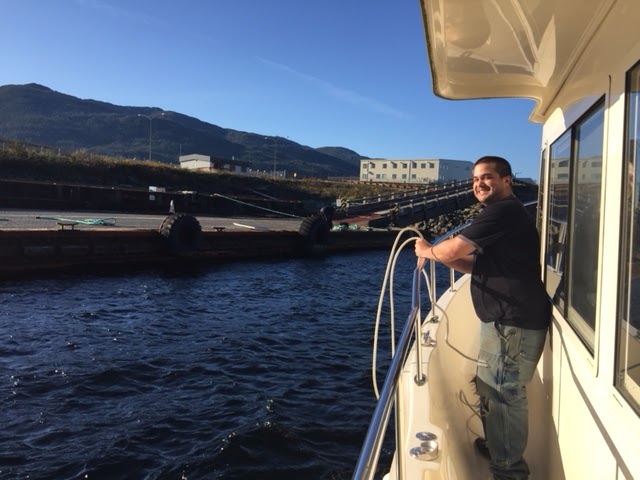
I did not get a picture of John from this trip, so I pulled this one from my archives.

This was from a trip we made in February of 2011, hence the warm clothing.
Wrangell is about 85 miles north from Ketchikan, and the first part of the trip is in Clarence Strait, which can be very rough. But we had a good forecast for that day and we were fortunate to have a nice smooth run up Clarence Strait and into Ernest Sound.

This map snippet shows the route from Bar Harbor to Meyers Chuck, about 32 miles, most of it pretty exposed in Clarence Strait. Maps are deceptive, and they make it look like you can go anywhere at anytime. Not so. This is big water and it can be very dangerous.

This map snippet shows the route from Meyers Chuck up through Ernest Sound and then Zimovia Strait to Wrangell. After you turn that corner at Meyers Chuck and get part way up into Ernest Sound it is mostly protected waters. It may be windy, but there probably won't be big seas to deal with.
I had a route already built into my Garmin navigational unit and it provides a wealth of information on the trip, including estimated arrival time.
I bumped the speed up a little bit and that brought our estimated arrival time into Wrangell at just about 7:30 PM, right before dark.
We arrived right on time and got hold of the Wrangell Harbor Master by VHF radio in order to get transient moorage and shore power at Heritage Harbor.
We had a late dinner of spaghetti and salad after which we were both ready for bed.
It was a quiet night in the harbor, and in the morning we pulled out about 6 AM destined for Petersburg.
In order to get up to Petersburg you have to transit the Wrangell Narrows. I have made that transit many times, but it is always a bit of a challenge to get through there. It is very shallow and very narrow in places, and the tides and currents are significant. On this trip we hit the currents just right and had a very helpful push as we made our way up through the Narrows.

This map snippet shows the route from Wrangell (on the right) over to the southern entrance to Wrangell Narrows (left side). It's a little over 20 miles.
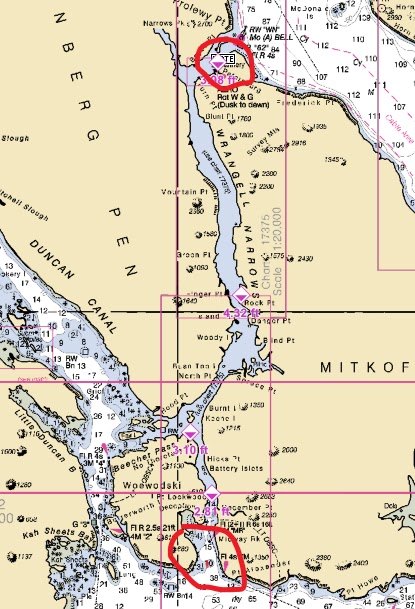
This map snippet shows the Wrangell Narrows, with the southern entrance circled in red at the bottom, and Petersburg circled in red at the top. I do not have a formal route charted through the Narrows themselves because there really is only one route - you follow the navigational markers. It's about another 20 miles up through the Narrows to Petersburg.
At the base of the Narrows we saw the USCG Cutter Bailey Barco (sp?) anchored, and we saw their large red inflatable go racing past us at one point. They just waved as they went by.
We worked our way up through the Narrows and were just about to pull into the fuel dock in Petersburg when we were hailed on the VHF radio by the inflatable from the Bailey Barco that they were going to come aboard and do a safety check. They don't ask, they tell - they have guns.
A safety check is where they check for things like life jackets, flares, fire extinguishers, paper work, etc.
We pulled into the fuel dock and they did the inspections there.
They also had on board a Federal Fisheries officer, who was interested in whether we had been fishing and whether we had any fish on board. I told him we had not been fishing but that I had some frozen fish in my freezer that I had brought from home.
He took exception to the frozen halibut and said it was a violation to have frozen fish on board that was in such a condition that they could not tell how many had been caught. He said he would not fine me (Thanks!) but he would send me a formal letter of violation.
I passed the USCG safety inspection with no violations, and we took on some fuel, and made our way into a slip. By now it was about noon.
 |
We were in North Harbor, just at the base of the ramp
|
Petersburg has 3 harbors: North Harbor, Middle Harbor, and South Harbor. My contact at Alaska Commercial Electronics, the company installing the autopilot, had asked me to get into North Harbor so that it was close to their shop. Just by chance he was in the harbormaster's office when we pulled in so that helped us get a good slip right near the base of the ramp.
 |
| Petersburg Harbors |

This interesting barge with a truck cab on top was here when we came through last summer.
I think it is the base from which a welding shop works.
You can't tell from this photo but there was a big metal barge on the inside of the Pegasus, and they would fire up a welder or a metal cutter from time to time and work on the barge.
 |
| Faraway at her slip in North Harbor |
John and I shared a last lunch and he left for a flight back to Ketchikan at just about the same time the guys from Alaska Commercial Electronics came down to start work on the autopilot.
For those that don't know, an autopilot on a boat is an electronic device that allows the operator to set in a compass course, and the autopilot will then steer the boat on its own. It can do many other things if it is integrated into a navigational unit, but my installation was just to install the autopilot.
When a boat is being steered by an autopilot the operator still has the responsibility to be at the helm and watch over the progress of the boat. By maritime law a boat is required to have someone at the helm at all times, even at anchor, when the boat is not tied to a dock.
They worked on the autopilot most of Thursday afternoon, and all of Friday.

This is the lower helm station, opened up so they could get to the hoses and wiring underneath it.
On this boat the lower helm station is an option, and the upper helm station on the flybridge is standard.

This is the DC (Direct Current) distribution panel opened up so they could add a new breaker for the autopilot.
One of the components of the autopilot system is a hydraulic pump, which is installed down in the engine room, in the stern, near the rudders. Even though the pump they installed was brand new it was defective. So that delayed us a bit while they scoured SE Alaska trying to find a replacement pump.
They finally found one in Juneau and one of the guys came back on Saturday afternoon and installed it. Then we took the boat out for a short sea trial so that we could confirm that it worked, and he could show me how to use it.

That black unit in the middle is the control unit for the new Furuno autopilot at the lower helm station.

An identical control unit was installed to the left of the gauges on the flybridge helm station.
These control units are just part of the system. There is a processor and an electronic compass mounted down below out of view, and the hydraulic pump and a rudder angle sensor are also mounted below, out of view.

That gold colored thing on the right is the "steering ram" that actually moves the rudders.
The black pump is in the middle, and it receives signals from the processor that tells it whether the boat needs right rudder or left rudder in order to achieve or stay on the desired compass setting.
The smaller black unit on the left is the rudder angle sensor. It just moves along with the rudders and tells the processor the angle that the rudders are on, such as 10 degrees to port, or 15 degrees to starboard.
The processor and the compass are tucked into a little shaft where it was basically impossible to get good photos of them.
At some point I will probably connect the autopilot to my Garmin GPS navigational unit and then the autopilot will have much more of its functionality unlocked and available to me.
With the autopilot installation finished there was no need to stay in Petersburg, so the next morning, Sunday, I made my way south through the Wrangell Narrows to Wrangell. I waited until the tides and currents in the Narrows were favorable and timed it just right to catch a boost all the way down through the Narrows. I have made that trip before when the currents were not favorable and it is very discouraging. You are burning lots of fuel but barely making any progress. It's well worth waiting for the favorable currents.

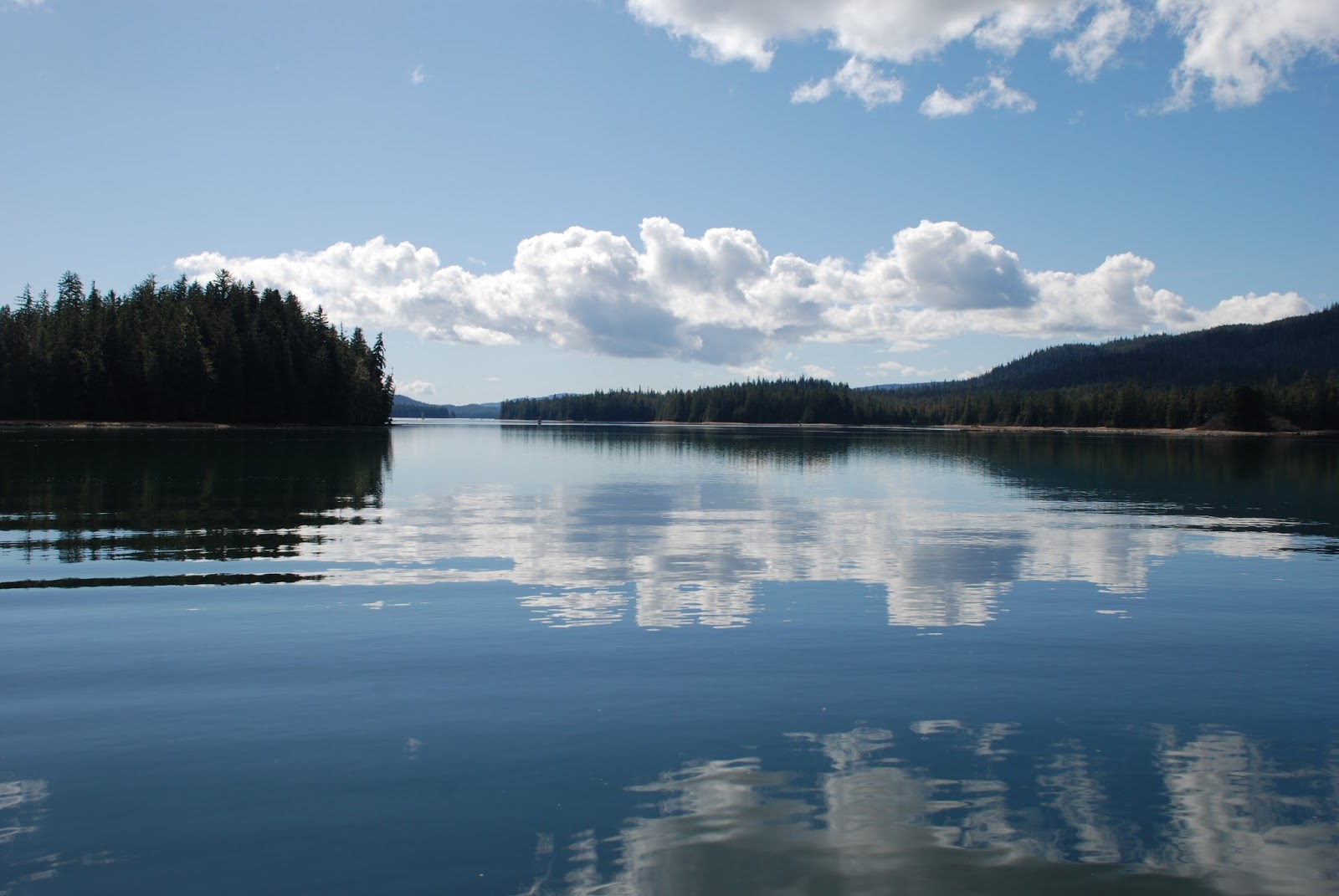
The ride down was beautiful. I just had to stop at one point and take some photos. I should point out that the ripples showing in the photo up above were from my boat wake when I stopped. It was really just glassy calm and serenely beautiful.
I did not use the autopilot much in the Narrows because there are a lot of turns and it is a winding route. But once you pop out of the Narrows on the southern end you still have about 20 miles or so to get to Wrangell. I did use the autopilot there. It did not have to work very hard because the seas were very calm.
At one point it crashed, for lack of a better word, with a "Rudder Drive Error." I looked it up in the manual and it said to shut down the system and restart it, which I did. It worked OK after that. The guys in Petersburg said there was probably some remaining air in the new hydraulic hoses that needed to be bled out.
I made it down to Wrangell and got tied up in exactly the same spot at Heritage Harbor that John and I had been on the north bound leg of this trip.
I was not scheduled to be hauled by the Wrangell Boat Shop until Wednesday afternoon and I had arrived on Sunday evening. On Monday morning I checked in with them to see if they could take me in early, but no such luck, they were tightly scheduled. So I just had to hang out and wait until Wednesday afternoon.

These 2 eagles were standing guard at the entrance to the harbor for most of the time that I was there.

There is a fish processing plant of some sort right inside the entrance to the harbor. I don't know its name. From time to time commercial boats would pull up in front and unload fish, looked like mostly halibut to me. The crane operator uses that yellow crane to drop a bin of sorts down into the hold. Then crewmen fill it up with fish, and then it is hoisted back up. Every once in awhile I would see a big halibut come up that was just tied to the end of the hoist, because it was too big to fit into the bin.


Some of my neighbors at Heritage Harbor.
That huge vessel the Bulldog was there when we came through last summer. Here is a photo from that trip.

You can see that it has been painted bright blue since we were here last. The vessel appears to be owned by Trident Seafoods, and is probably used as a fish packer. Fish packers go out to the fishing grounds and the commercial boats can sell their fish directly to the packer without having to run all the way to town.
On Wednesday afternoon, right on schedule, the Wrangell Boat Shop guys hauled Faraway out of the water. They use a cradle sitting on rail tracks, and then a big winch pulls the cradle with the boat in it up inside a covered area.

I had never been on board when they hauled it out on a cradle like this, so it was a new experience for me. I wasn't there last year when they did it. They had a couple of young people from the WBS on board, one on each side, to help guide things along. We were all waiting for something to happen when Allie, the WBS employee on the starboard side, opened the door near the lower helm and informed me that there was a "slight problem with the winch," and that Pat, the owner had to drive over to the store and get some bolts. Knowing that the winch that is supposed to haul my 10+ ton boat out of the water needs some new bolts did not exactly boost my confidence at that moment.


My plan this year was to stay/sleep on the boat while it was out of the water. Last year when I did this maintenance session I took the ferry back to Ketchikan, and then flew back when the boat was ready.
Since the boat was high and dry I could not use the toilet on board. It draws in salt water for flushing, but of course that doesn't work when it is out of the water. But not to worry, the WBS staff provided my access to their shop rest room, and I was grateful for it.

The boat sat at a slight stern down angle on the cradle which made moving around inside a little weird. It also creaked and groaned when I moved from side to side, so it made me wonder if they had ever had one slide off the cradle. I didn't ask - not sure I really wanted to know.
In any case they did some necessary spring maintenance tasks -
pressure wash the bottom
paint the bottom
replace all the exterior zincs
replace all the pencil zincs on the engines
replace the elements in the Racor fuel filters
replace the glow plug in the diesel furnace
check all belts, all good
replace raw water impellers in the main engines
replace the O rings in the seas strainers for the main engines
replace the O ring in the sea strainer for the generator
check the thru-hull fittings for the sea water cooling system, all good
diagnose and repair a freshwater leak from the hot water heater
replace all wiper blades
bleed the air out of the hydraulic steering system
Boats need continual maintenance or things just start breaking down.
Some of the above tasks I used to do myself, but as I have gotten older it is much harder for me to crawl around that engine room like I used to. I don't bend as easily as I once did. So some of these tasks are actually impossible for me to do now because I cannot contort my body into the required position to perform them.
I will be taking the boat about 900 miles from Ketchikan down to Gig Harbor beginning around the first week of May and I wanted as much preventive maintenance done as possible. I want to do as much as I possibly can to insure an enjoyable and break down free voyage. Time will tell how well I did on that score.
The Wrangell Boat Shop guys were done with the boat, or so we thought, by Friday afternoon. Their facility is in what is called the "Inner Harbor" in Wrangell, and boats can only be hauled or launched at high tide. So they launched me about 4:30 PM on Friday, in a driving cold rain.

The red star approximates where the WBS is located. Very shallow back there.
When I first got back in the water I had one of the guys from the yard get down in the engine room when I started the engines to insure that there were no leaks - there were none. Since they had replaced an O-ring on the generator I also wanted to start the generator to insure no leaks, but the generator would not even begin to turn over.
I moved the boat over to my same old spot at Heritage Harbor and a guy from the boat yard came over in the morning and fixed the generator problem. When they had removed the DC distribution panel a wire had slipped off its connection. Easily fixed.
On Saturday morning at about 10:30 AM I pulled out of Heritage Harbor and headed south towards Ketchikan. Neither my wife nor I really wanted for me to do this leg of the trip alone, but we just couldn't come up with any viable plan to get me some help. I have had some issues with vertigo attacks in the past and they can be quite disabling.
The weather and sea conditions were great to start out. The big question would be what is it like in Clarence Strait, the last 32 miles of the trip?
I used the autopilot for about 80% of the steering on the way home and it never crashed again.
Meyers Chuck is a little community right at the "corner" where you turn into Clarence Strait. It is really your last chance for refuge. Once you commit and continue on past Meyers Chuck there is no place to hide from bad weather. Once you've gone more than 5 miles or so you really can't turn back if it's real bad either. So that is a big decision point.
I had listened to the marine weather on the radio, and of course I could see what I could see with my own eyes when I got to Meyers Chuck. The forecast was reasonable, 15 knots with seas to 3', and the water looked fine as far as I could see, so I went for it. The forecast for Sunday and Monday was miserable and I didn't want to be stuck in Meyers Chuck for several days waiting for good weather.
It is about 32 miles from Meyers Chuck to Bar Harbor, and about the first 10 miles were fine. After that it started to get bad, and continued to get worse as each mile went by. I could no longer use the autopilot due to sea conditions, and I could not go down below and prepare the cabin for rough water.
It was not the worst 22 miles I've ever done, but I would say it was about a 7 on a scale of 1 to 10, with 10 being the worst.
I had a 1 gallon unopened can of bottom paint sitting on the starboard bench seat, and it came flying off with a thud as it hit the flybridge deck. Thank goodness it didn't pop open - that would have been a mess!
In any case, I battered through it and was fully inside Vallenor Point before it calmed down enough for me to go below and check the damage. It looked like a bomb had gone off in the cabin, which was what I expected.
I pulled into my home slip in Bar Harbor at about 8 PM, just as it was getting dark, in very calm conditions. I was very glad to be "home."
As I write this on Monday evening I can say that I would have never made it in on Sunday or Monday as it is still blowing hard out there.
The next big trip will be to Gig Harbor WA.